
Hematology Specialist Association 19 National Congress
Mais dadosDiabetes mellitus exerts detrimental effects that extend beyond glycemic imbalance, frequently involving hematological and renal systems. The coexistence of anemia and declining renal function in diabetes substantially increases cardiovascular risk [1]. HbA1c, as a marker of long-term glycemic control, may have significant implications for hematological indices and iron metabolism. Recent evidence suggests that alterations in iron handling and ferritin levels may be linked to both glycemic status and renal function [2,3]. The present retrospective study investigated the associations between HbA1c, estimated glomerular filtration rate (GFR), and hematological parameters in a real-world patient cohort.
MethodsData from 205 adult patients were retrospectively retrieved from the Internal Medicine Clinic of Düziçi State Hospital. The collected variables included hemoglobin (Hb), hematocrit (Hct), serum iron (Fe), total iron-binding capacity (TIBC), ferritin, HbA1c, and estimated GFR. Patients were categorized into two groups according to glycemic status: HbA1c <7% and HbA1c ≥7%. Spearman’s correlation analysis was applied to determine associations among variables. Group comparisons were performed between the two HbA1c subgroups using appropriate statistical tests depending on data distribution. Ethical approval was obtained from the Adana City Training and Research Hospital Scientific Research Ethics Committee (Decision No: 508, Date: 08.05.2025).
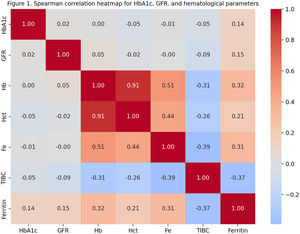
ResultsNo significant association was observed between HbA1c and hemoglobin or hematocrit. A borderline positive correlation was identified between HbA1c and ferritin (r=0.14, p≈0.05). GFR demonstrated a weak but significant correlation with ferritin (r=0.15, p<0.05). Hemoglobin and hematocrit showed strong positive associations with serum iron, whereas TIBC was inversely correlated with ferritin.
When comparing patients by glycemic status, those with HbA1c ≥7% exhibited slightly lower hemoglobin, hematocrit, and GFR values, alongside modestly higher ferritin levels compared with patients with HbA1c <7%. These findings are summarized in Table 1.
A correlation heatmap integrating all variables is presented in Figure 1, where strong positive associations are observed between Hb, Hct, and serum iron, while TIBC and ferritin demonstrate an inverse relationship. Borderline positive associations of ferritin with both HbA1c and GFR are also highlighted.
Discussion and ConclusionThis retrospective analysis of 205 patients demonstrated that glycemic control, as assessed by HbA1c, does not directly predict hemoglobin or hematocrit levels. However, a borderline positive correlation with ferritin was observed, suggesting a potential link between glycemic status and iron metabolism. GFR also exhibited a weak positive correlation with ferritin, consistent with previous reports that renal dysfunction alters iron homeostasis and contributes to anemia in diabetes [4,5].
Expected associations among hematological indices were confirmed, such as strong correlations of hemoglobin and hematocrit with serum iron, and the inverse relationship between TIBC and ferritin. These findings reinforce the integrated role of iron regulation in the pathophysiology of diabetes.
Overall, the results suggest that while HbA1c may not serve as a strong predictor of anemia itself, it may indirectly influence iron metabolism, potentially through inflammatory or renal mechanisms. Clinical management of diabetes should therefore extend beyond strict glycemic control, incorporating comprehensive evaluation of renal function and iron status.
Table 1. Comparison of hematologic and renal indices between glycemic control groups (HbA1c <7 vs ≥7).
Figure 1. Spearman correlation heatmap for HbA1c, GFR, and hematological parameters (Hb, Hct, Fe, TIBC, Ferritin).