
Sugestões
Idioma
Informação da revista
Vol. 48. Núm. 3.
(Julho - Setembro 2026)
Citação
Citação
Compartilhar
Baixar PDF
Mais opções do artigo
Visitas
395
Vol. 48. Núm. 3.
(Julho - Setembro 2026)
Letter to the Editor
Acesso de texto completo

MPL mutations are over-represented in patients with dual driver-mutated myeloproliferative neoplasms: an Irish cohort study

Visitas
395
Laura Kearneya, Claire Andrewsb, Rachel Brodiec, Ezzat Elhassadid, Helen Enrighte, Kamal Fadallab, Michael Fayf, Catherine Flynng, Anne Fortunef, Andrew Hodgsonh, Senthil Kumard, Kanthi Pererai, Jeremy Sargentj, Liam Smythb, Stephen E. Langabeera,
Autor para correspondência
slangabeer@stjames.ie

Corresponding author at: Cancer Molecular Diagnostics, St. James’s Hospital, Dublin D08 W9RT, Ireland.
a Cancer Molecular Diagnostics, St. James’s Hospital, Dublin, Ireland
b Department of Haematology, St. Vincent’s University Hospital, Dublin, Ireland
c Department of Haematology, Cork University Hospital, Cork, Ireland
d Department of Haematology, University Hospital Waterford, Waterford, Ireland
e Department of Haematology, Tallaght University Hospital, Dublin, Ireland
f Department of Haematology, Mater Misericordiae University Hospital, Dublin, Ireland
g Department of Haematology, St. James’s Hospital, Dublin, Ireland
h Department of Haematology, Sligo University Hospital, Sligo, Ireland
i Department of Haematology, Midlands Regional Hospital, Tullamore, Ireland
j Department of Haematology, Beaumont Hospital, Dublin, Ireland
Ver más
Este item recebeu
Informação do artigo
Texto Completo
Bibliografia
Baixar PDF
Estatísticas
Tabelas (1)
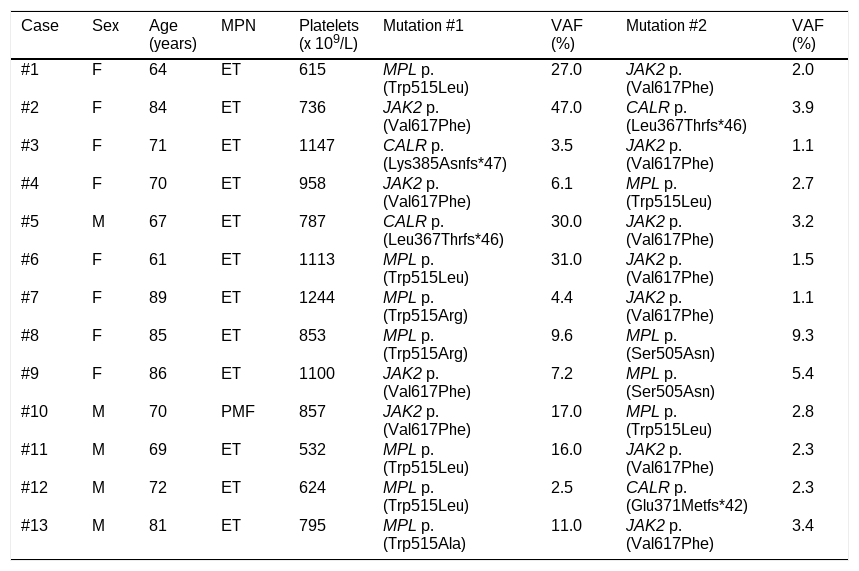
Table 1. Myeloproliferative neoplasm patients with dual driver mutations. Largest variant allele frequency (VAF) mutation first.
Tabelas
Texto Completo
Dear Editor

Singular mutations in either JAK2, CALR or MPL genes are the most frequent drivers of the myeloproliferative neoplasms (MPN) with variants in other myeloid-associated genes contributing to disease phenotype and clinical course. MPN molecular diagnostic algorithms can be either sequential or simultaneous with each technology employed possessing its own sensitivities, specificities and clinical applicability [1]. An increasingly recognised, minor subgroup of MPN patients, particularly those with essential thrombocythemia (ET) and primary myelofibrosis (PMF), harbor two driver mutations [2]. Prior evidence suggests a second driver mutation occurs more commonly in low variant allele frequency (VAF) JAK2 V617F-mutated MPN with the presence of two mutations affecting the phenotype such as a higher platelet count [3,4].

In order to evaluate the incidence and molecular diversity of the dual driver phenomenon in the Irish MPN population, an audit was performed on all requests received at a center for molecular diagnosis of MPN. Mutations in JAK2 (exons 12 and 14), CALR (exon 9), and MPL (exon 10) were identified using a previously described single-molecule, molecular inversion probe-based next-generation sequencing (NGS) methodology [5,6]. From March 2023 to November 2025, 1275 consecutive, new patients were identified with either JAK2 V617F (n = 1011; 79.3%), JAK2 exon 12 (n = 12; 0.9%), CALR exon 9 (n = 168; 13.2%) or MPL exon 10 (n = 84; 6.6%) mutations. This cohort consisted of 665 females and 610 males with a median age of 68 years (range: 21–97 years). Of these 1275 patients, thirteen (1.0%) were identified with ET (n = 12) or PMF (n = 1) with two driver mutations. This group comprised eight females and five males with a median age at presentation of 71 years (range: 61–89 years) and a median presenting platelet count of 853 × 109/L (range: 562–1244 × 109/L) (Table 1). Of the 26 mutations in 13 patients, eleven (42.3%) were JAK2 V617F, eleven (42.3%) were in MPL exon 10 and four (15.4%) were in CALR exon 9. Of the eleven patients with a JAK2 V617F, seven (63.6%) had a VAF ≤5% (Table 1).

Table 1.

Myeloproliferative neoplasm patients with dual driver mutations. Largest variant allele frequency (VAF) mutation first.

Case  Sex  Age (years)  MPN  Platelets (x 109/L)  Mutation #1  VAF (%)  Mutation #2  VAF (%) 
#1  F  64  ET  615  MPL p.(Trp515Leu)  27.0  JAK2 p.(Val617Phe)  2.0 
#2  F  84  ET  736  JAK2 p.(Val617Phe)  47.0  CALR p.(Leu367Thrfs*46)  3.9 
#3  F  71  ET  1147  CALR p.(Lys385Asnfs*47)  3.5  JAK2 p.(Val617Phe)  1.1 
#4  F  70  ET  958  JAK2 p.(Val617Phe)  6.1  MPL p.(Trp515Leu)  2.7 
#5  M  67  ET  787  CALR p.(Leu367Thrfs*46)  30.0  JAK2 p.(Val617Phe)  3.2 
#6  F  61  ET  1113  MPL p.(Trp515Leu)  31.0  JAK2 p.(Val617Phe)  1.5 
#7  F  89  ET  1244  MPL p.(Trp515Arg)  4.4  JAK2 p.(Val617Phe)  1.1 
#8  F  85  ET  853  MPL p.(Trp515Arg)  9.6  MPL p.(Ser505Asn)  9.3 
#9  F  86  ET  1100  JAK2 p.(Val617Phe)  7.2  MPL p.(Ser505Asn)  5.4 
#10  M  70  PMF  857  JAK2 p.(Val617Phe)  17.0  MPL p.(Trp515Leu)  2.8 
#11  M  69  ET  532  MPL p.(Trp515Leu)  16.0  JAK2 p.(Val617Phe)  2.3 
#12  M  72  ET  624  MPL p.(Trp515Leu)  2.5  CALR p.(Glu371Metfs*42)  2.3 
#13  M  81  ET  795  MPL p.(Trp515Ala)  11.0  JAK2 p.(Val617Phe)  3.4 

In this European cohort, 1% of MPN patients presented with dual driver mutations, similar to the recently described rate of 1.5% [7]. The association of dual driver mutations in patients with a low JAK2 V617F VAF is also confirmed [8,9]. In agreement with a proposal that a platelet count higher than 700 × 109/L acts as a general discriminator for identifying dual driver mutations [4], only three of thirteen patients presented with a lower platelet count. The relatively small size and short follow-up of this cohort preclude any clinical correlation. In MPN patients with a single driver mutation, MPL exon 10 mutations are present in approximately 5% and 9% of patients with ET and PMF respectively with the W515L allele being most prevalent. In contrast, MPL exon 10 mutations account for >40% of variants in this dual-driver population; these include the less common MPL S505N, W515R, and W515A mutations. This study provides confirmation of the prevalence of this molecular subtype in a national MPN cohort and demonstrates a distinct pattern of MPL mutations in dual driver MPN. This brief audit further underscores the molecular and clonal complexity of this subset of MPN patients.

Funding

This research received no specific grant from any funding agency in the public, commercial, or not-for-profit sectors.

Ethical approval

This non-interventional, observational study was performed under routine standard of care procedures in accordance with the 1964 Helsinki declaration and its later amendments. Informed consent was obtained from participants at the referring centers.

Data availability

The data that support the findings of this study are available from the corresponding author upon reasonable request.

Conflicts of interest

All authors declare no potential conflicts of interest with respect to the research, authorship, and/or publication of this article.


References
[1]
X. Liu, K. Krishnamurthy, R. Naeem, D. Yitzchak Goldstein.
A comparison of sequential polymerase chain reaction-based cascade testing vs next-generation sequencing in molecular profiling of myeloproliferative neoplasms: improving testing strategies in light of evolving molecular landscapes.
Lab Med, 56 (2025), pp. 511-516
[2]
Y. Wang, F. Ran, J. Lin, J. Zhang, D. Ma.
Genetic and clinical characteristics of patients with Philadelphia-negative myeloproliferative neoplasm carrying concurrent mutations in JAK2 V617F, CALR and MPL.
Technol Cancer Res Treat, 22 (2023),
[3]
B. Lebecque, C. Croizier, T. Tassin, E. Louis, N. Tribalat, W. Bombardier, et al.
Contribution of molecular characterization to the diagnosis of MPN in patients with a low JAK2 V617F variant allele fraction in a real-world cohort.
Ann Hematol, 104 (2025), pp. 1587-1596
[4]
B. Mora, C. Siracusa, E. Rumi, M. Maffioli, I.C. Casetti, D. Barraco, et al.
Platelet count predicts driver mutations co-occurrence in low JAK2 mutated essential thrombocythemia and myelofibrosis.
Leukemia, 35 (2021), pp. 1490-1493
[5]
A. Eijkelenboom, E.J. Kamping, A.W. Kastner-van Raaij, S.J. Hendriks-Cornelissen, K. Neveling, R.P. Kuiper, et al.
Reliable next-generation sequencing of formalin-fixed, paraffin-embedded tissue using single molecule tags.
J Mol Diagn, 18 (2016), pp. 851-863
[6]
L. Lee-Tokar, L. Kearney, S.E. Langabeer.
Detection of JAK2 exon 12 mutations in suspected polycythemia vera by next-generation sequencing.
Clin Lab, 68 (2022), pp. 244-246
[7]
R. He, P.L. Ollila, X. Zhang, J. Yuan, M. Shi, A. Rangan, et al.
Prevalence of concurrent (double-positive) JAK2, CALR, or MPL mutations and corresponding clinicopathological features: analysis of 21556 Mayo Clinic NGS studies including 2651 informative cases.
Am J Hematol, 100 (2025), pp. 2431-2435
[8]
F. Usseglio, N. Beaufils, A. Calleja, S. Raynaud, J. Gabert.
Detection of CALR and MPL mutations in low allelic burden JAK2 V617F essential thrombocythemia.
J Mol Diagn, 19 (2017), pp. 92-98
[9]
O. Mansier, D. Luque Paz, J.C. Ianotto, Y. Le Bris, A. Chauveau, F. Boyer, et al.
Clinical and biological characterization of MPN patients harboring two driver mutations, a French intergroup of myeloproliferative neoplasms (FIM) study.
Am J Hematol, 934 (2018), pp. E84-E86
Copyright © 2026. Associação Brasileira de Hematologia, Hemoterapia e Terapia Celular
Baixar PDF
Idiomas
Hematology, Transfusion and Cell Therapy
Opções de artigo
Ferramentas