
Allogeneic hematopoietic stem cell transplantation is a standard treatment for hematologic diseases. While biological predictors of transplant success are well established, psychobiological factors such as depression and physical activity remain underexplored. This study investigates their influence on clinical outcomes and quality of life after allogeneic hematopoietic stem cell transplantation.
MethodsIn this prospective study, 42 patients undergoing transplantation (December 2020– December 2021) were assessed at four time points (T0–T3). Depression was assessed using the Patient Health Questionnaire-9, physical activity using the International Physical Activity Questionnaire, and quality of life using the Functional Assessment of Cancer Therapy-Leukemia and its Trial Outcome Index subscore. Bivariate correlations (p-value <0.05) were used to examine associations with clinical endpoints (leukocyte engraftment, GVHD, adverse events ≥ Grade III, relapse, mortality, and quality of life at six months).
ResultsHigher depression at T0 (Mean: 6.53; SD: 4.98) predicted lower global quality of life at T3 (r = -0.46; p = 0.04), but not clinical outcomes. Physical activity at T0 (Mean: 4290.3; SD: 4242.7) showed no significant associations. Older age (Mean: 57.7; SD: 10.2) was linked to a better Trial Outcome Index (r = 0.5; p = 0.02), higher global quality of life (r = 0.45; p = 0.04), and lower depression (r = -0.56; p = 0.005) at T3. Complications had no effect on quality of life or depression.
ConclusionDepression before allogeneic hematopoietic stem cell transplantation may predict poorer quality of life afterward. Older age was associated with better outcomes, suggesting rigid age limits for allogeneic hematopoietic stem cell transplantation should be re-evaluated.
Allogeneic hematopoietic stem cell transplantation (allo-HSCT) is associated with significant morbidity and mortality [1]. Thanks to improvements in the management of complications there has been a decrease in mortality from around 30% in 1989 to approximately 10% in 2016 [1]. Moreover, the implementation of reduced-intensity or non-myeloablative conditioning regimens enables elderly patients to become eligible for allo-HSCT [2].
Survival and complete remission (CR) rates after allo-HSCT vary significantly, as they depend on multiple factors like the type of underlying disease, molecular and cytogenetic changes, comorbidities, donor selection, conditioning therapy, the extent of acute graft-versus-host disease (aGVHD) and chronic graft-versus-host disease (cGVHD), and other treatment-related complications [3]. Apart from the immediate clinical consequences, allo-HSCT may also have long-lasting negative effects on the quality of life (QoL) [4] and can be a source of persistent depression [5]. However, the influence of psychobiological predictors on the course of an allo-HSCT has rarely been investigated. Wang et al. showed a significant association (p < 0.04) between depression before allo-HSCT and survival after allo-HSCT [6]. However, Pilay et al. were unable to identify any psychobiological parameter that could predict survival after allo-HSCT [7]. Likewise, for autologous hemopoietic stem cell transplantation, Dimeo et al. demonstrated an advantageous influence of increased physical activity (PA) on engraftment time and QoL. However, these effects have not yet been proven for allo-HSCT [8,9].
The aim of this study was to investigate the influence of psychobiological predictors such as depression and PA on treatment outcomes, survival and QoL after allo-HSCT.
MethodsStudy designThe P-POST study was a single-arm, prospective cohort study investigating whether psychological constructs and biological variables influence clinical outcomes and QoL six months after allo-HSCT. This analysis focuses on the impact of PA, depression, and age on the outcomes of allo-HSCT. We hypothesized that lower levels of depression and higher baseline PA would positively influence treatment success, side effect rates, and QoL, whereas age would not affect depression levels or QoL six months post-transplant. In addition, psychobiological aspects of the study such as the influence of treatment expectations were analyzed and will be published separately. Data were collected at four time points: at T0 (start of inpatient treatment), 15–20 days after the start of inpatient treatment (T1), at the end of inpatient treatment (T2; approximately 3–6 weeks after T0) and six months after the start of treatment (T3). The study was approved by the ethics committee of the Philipps University Marburg (Study 147/20).
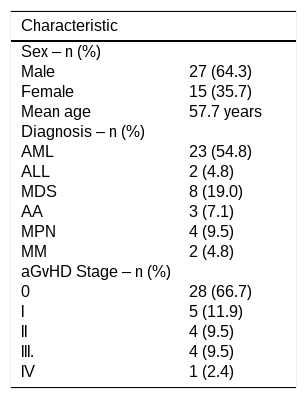
PatientsThe study was conducted at the University Hospital Marburg within the Department of Hematology, Oncology and Immunology. Recruiting took place from December 2020 to November 2021, with the final follow-up in June 2022. All candidates for allo-HSCT during this period were invited to participate. Inclusion criteria included age ≥18 years, sufficient cognitive capacity, language proficiency, and documented written informed consent. Of the 44 patients screened, two declined to participate, resulting in a final sample of 42 patients (mean age: 57.7 years; Standard deviation [SD]: 10.2; range: 31–69 years), including 15 females and 27 males (ratio: ∼1:1.8). Patient characteristics are summarized in Table 1.
Patient characteristics (n = 42).
AML: acute myeloid leukemia; ALL: acute lymphoblastic leukemia; MDS: myelodysplastic syndrome; AA: aplastic anemia; MPN: myeloproliferative neoplasms; MM: multiple myeloma; aGVHD: acute graft versus host disease.
The absolute and percentage frequencies of aGVHD according to Harris stages are shown for 42 patients (Stage 0 corresponds to the absence of aGVHD).
At baseline (T0), patients were informed about the study, and clinical and laboratory parameters were collected using standardized case report forms (CRF 1 and CRF 2; see Supplementary Table 1). Patients also completed a baseline paper-and-pencil questionnaire and an activity log (approximate completion time: 45 min). At T1, clinical and laboratory parameters (CRF 1, CRF 2) were reassessed, the first follow-up questionnaire was distributed, and patient motivation was evaluated. During T2, the activity log was collected, while all remaining procedures mirrored those of T1. Procedures at T3 followed the same protocol. Evaluated outcome variables (Supplementary Table 1) included mortality rates at day 100, at T3, and one year post-transplant; relapsed incidence at one year post-transplant; the incidence of cGVHD; and the staging of aGVHD at T3 using the Harris criteria [10]. The incidence of complications of Grade III or higher, according to the Common Terminology Criteria for Adverse Events (CTCAE) and Kidney Disease: Improving Global Outcomes (KDIGO) criteria, was recorded throughout the hospital stay. Furthermore, time to leukocyte and platelet engraftment post-allo-HSCT was documented.
Depression was measured using the Patient Health Questionnaire-9 (PHQ-9) [11]. Each item is scored from 0 (not at all) to 3 (nearly every day), with a maximum score of 27 points. Scores of 0–4 indicate minimal or no depression, 5–9 mild, 10–14 moderate, 15–19 moderately severe, and 20–27 severe depression [12]. The tool has shown to correlate with post allo-HSCT QoL in other trials [13,14].
PA was assessed using the short form of the International Physical Activity Questionnaire (IPAQ), evaluating the frequency and duration of vigorous, moderate, and walking activities, as well as sitting time over the past week [13]. Based on the IPAQ, Metabolic Equivalent of Task (MET)-minutes are calculated as the product of the respective metabolic equivalent values of the activity (MET) and their duration in minutes per week (MET-min/wk). Activities are weighted in metabolic equivalents: walking (3.3 METs), moderate activity (4.0 METs), vigorous activity (8.0 METs), and sitting (1.0 MET) [15].
Finally, global QoL was measured using the Functional Assessment of Cancer Therapy-Leukemia (FACT-Leu) total score [16], and treatment-related Trial Outcome Index QoL using the FACT-Leu Trial Outcome Index (TOI) score at T3. Responses to the 44 items are rated on a five-point Likert scale, with higher scores indicating a better QoL [17]. The FACT-Leu TOI consists only of the physical, functional and leukemia-specific subdomains of the FACT-Leu. Maximums of 176 points could be achieved for the FACT-Leu and 124 points for the FACT-Leu TOI [18].
Data were analyzed using IBM SPSS Statistics (Version 29) (IBM Corp.). Descriptive analyses were used to illustrate demographic characteristics of the study population as well as clinical status before, during, and after allo-HSCT. Levels of depression, PA, and QoL are described. Pairwise deletion was applied for missing values. Bivariate correlations were calculated with a significance level of p < 0.05; Due to slower-than-expected recruitment, the planned use of multivariate models was abandoned. Corrections for multiple testing were not performed due to the exploratory nature of this study.
ResultsClinical dataAML was the most common indication for allo-HSCT (n = 23; 54.8%). Other diagnoses are presented in Table 1. During a mean follow-up period of 196 days, six patients (14.3%) died within the first 100 days, and a total of 12 patients (28.6%) died by T3. After one year, a total of 18 (42.9%) patients had died. Relapse after allo-HSCT was observed in 13 (31%) cases within one year. The mean time until leukocyte engraftment (>1 × 10⁹/L) was 21 days (SD: 5.88; range: 10–41) and 24 days (SD:16.02; range:11–92) until thrombocytic engraftment (>10 × 109/L). One patient failed to achieve leukocytic engraftment and six patients failed to achieve thrombocytic engraftment. All patients experienced predictable, treatment-induced hematologic toxicity corresponding to Common Terminology Criteria for Adverse Events (CTCAE) Grade ≥III. Specifically, universal conditioning-related neutropenia and thrombocytopenia of Grades ≥III were observed across the entire cohort. Supplementary Table 2 summarizes the complications between T0-T2.
Twenty-eight patients (66.7%) showed no signs of aGVHD (stage 0). The remaining 14 (33.3%) developed aGVHD: five (11.9%) stage I, four (9.5%) stage II, four (9.5%) stage III, and one (2.4%) stage IV (Supplementary Table 3). In many cases, several organ systems were affected simultaneously. The development of cGVHD was identified in seven (16.7%) cases.
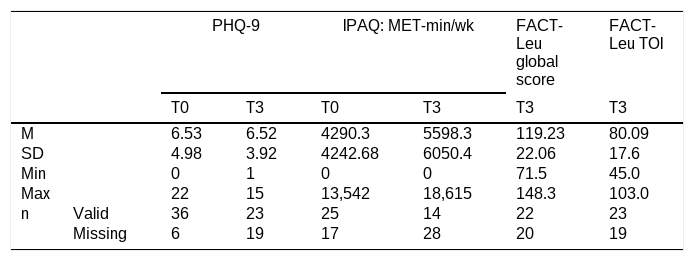
Psychometric dataDepression and activityThe average PHQ-9-score at T0 was 6.53 (SD: 4.98; Q1: 3; Q3: 9) for 36 patients and 6.52 at T3 (n = 23; SD: 3.92; Q1: 4; Q3: 10) (Table 2). Data were missing for six patients at T0 due to non-compliance while at T3 data were missing for 19 cases; 12 due to death and seven due to non-compliance. A maximum of 36 points could be achieved in the study questionnaire which was scaled back to Kroenke’s maximum of 27 points before data analysis [12]. Using a screening cut-off of 10 points [12], there would be ten cases (27.8%) at T0 with suspected mild depressive disorder.
Total Patient Health Questionnaire-9 (PHQ-9) score at T0 and T3, Metabolic Equivalent of Task - Minutes per week (MET-min/wk) according to the International Physical Activity Questionnaire (IPAQ) at T0 and Functional Assessment of Cancer Therapy - Leukemia (FACT-Leu) global scores and trial outcome index (TOI).
M: Mean; SD: Standard Deviation; Min: Minimum; Max: Maximum.
MET-min/wk: Metabolic Equivalent of Task - Minutes per week as a unit of physical activity.
Regarding PA in MET-min the mean measured values at T0 were 4290.3 MET-min/wk (SD: 4242.68; Q1: 615; Q3: 6639) and at T3 the mean was 5598.3 MET-min/wk (SD: 6050.4; Q1: 816.8; Q3: 10,095.8) (Table 2). At T0, two patients (8%) reported 0 MET-min/wk, and six (24%) remained below 600 MET-min/wk. At T3, another two patients (14.3%) reported 0 MET-min/wk, and three (21.4%) remained below 600 MET-min/wk. It should be noted that the analysis of MET-minutes could not be performed for 17 patients at T0 due to non-adherence, nor for 28 patients at T3 (comprising 12 deaths and 16 cases of non-adherence).
Treatment-related quality of lifeThe FACT-Leu, calculated as the sum of all subscales, assesses overall QoL, whereas the FACT-Leu TOI accentuates physical and functional well-being in patients with hematological neoplasms. At T3, data from 22 patients for FACT-Leu and 23 patients for FACT-Leu TOI were included in the analysis (Table 2). The FACT-Leu could not be evaluated in 20 patients and the FACT-Leu TOI could not be determined in 19 patients due to death (n = 12) or lack of patient compliance (eight cases for global and seven cases for TOI-score) (Table 2).
The mean FACT-Leu global score of 22 patients was 119.23 (SD: 22.06 Q1: 108.5, Q3: 134.2), and the mean FACT-Leu TOI score was 80.09 (SD: 17.6, Q1: 74, Q3: 94) (Table 2). Their values were below those reported in the validation study (two months after allo-HSCT) [18]. Reference values for a time point six months after allo-HSCT are not available. The evaluation and adjustment for missing values were performed according to the FACIT group guidelines [19].
Using the FACT-Leu and FACT-Leu TOI, the impact of depression on QoL was examined in 28 patients at T3. Missing correlations (n = 14) were due to missing PHQ-9 data at T0 or missing FACT-Leu data at T3.
The FACT-Leu total score shows a significant correlation between depression at T0 and QoL at T3 (r = −0.456; p = 0.038). The negative correlation can be interpreted as a decrease in QoL at the end of the study for higher depression scores at T0. A similar, but non-significant, trend was observed for the TOI (r = −0.372; p = 0.089). Based on the total population at T3 (n = 30), correlations were calculated at 73.3% (TOI: n = 22) and 70% (FACT-Leu total: n = 21). In summary, higher levels of depression at T0 are associated with poorer QoL at T3.
Influence of depression and activity on treatment outcome and quality of lifeIt was assumed that less depressed patients at T0 (measured using the PHQ-9) would show a favorable treatment outcome of allo-HSCT.
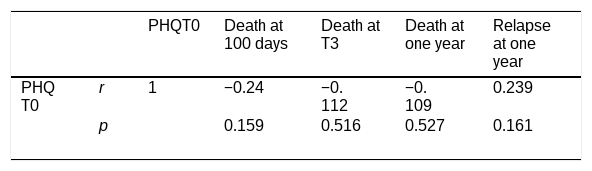
Point-biserial correlations between depression and the dichotomous variables of mortality (at 100 days, six months, and one year) are presented in Table 3. There were no significant associations between increased depression and lower survival or higher recurrence rates (p > 0.05).
Correlations between Patient Health Questionnaire-9 (PHQ-9) at T0 and the incidence of deaths and recurrences in 36 patients who completed the questionnaire.
| PHQT0 | Death at 100 days | Death at T3 | Death at one year | Relapse at one year | ||
|---|---|---|---|---|---|---|
| PHQ T0 | r | 1 | −0.24 | −0.112 | −0.109 | 0.239 |
| p | 0.159 | 0.516 | 0.527 | 0.161 |
Point-serial correlations are shown. PHQ-9 total score at T0.
R: regression coefficient; p: p-value; n: number of valid correlations in accordance with the study hypothesis. *p < 0.05, **p < 0.01, ***p < 0.001.
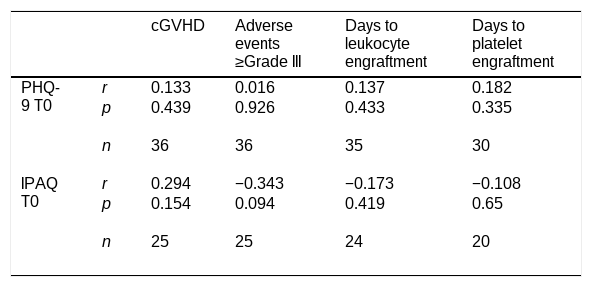
Point-biserial correlations regarding the influence of depression on the dichotomously coded incidences of higher-grade adverse events according to the CTCAE and KDIGO criteria after allo-HSCT and on the occurrence of cGVHD cases, as well as Pearson correlations for the relationship between the metric variables, are presented in Table 4. Moreover, the relationship between depression and the ordinally coded severity of aGVHD according to the Harris criteria using Spearman correlations was analyzed (between T0 and T3).
Correlations of Patient Health Questionnaire-9 (PHQ-9) and International Physical Activity Questionnaire (IPAQ) scores at T0 with clinical outcomes, including chronic graft-versus-host disease (cGVHD) incidence, acute graft-versus-host disease (aGVHD) staging, occurrence of complications ≥Grade III, and engraftment kinetics up to T3 (n=36).
cGVHD: chronic graft-versus-host disease; aGVHD: acute graft-versus-host disease (graded according to Harris stages); r: correlation coefficient; p: p-value; n: sample size.
Point-biserial correlations were calculated for relationships involving binary variables (cGVHD and adverse events), whereas Pearson correlations were calculated for continuous variables (engraftment kinetics). Adverse events were graded using the Common Terminology Criteria for Adverse Events (CTCAE) and Acute Kidney Injury Network (AKIN) criteria.
*p < 0.05, **p < 0.01, ***p < 0.001.
Data from six of 42 patients were excluded due to missing PHQ-9 questionnaires resulting from non-compliance. For patients who died prior to study completion, clinical parameters were recorded up to the time of death and included in the analysis. Sample sizes for leukocyte and platelet engraftment correlations were further adjusted to n=35 and n=30, respectively, due to the absence of engraftment by T3.
Thirty-six correlations were established based on 36 available PHQ-9 data sets and clinical data concerning aGVHD. Increasing depression did not influence the timing of leukocyte (r = 0.137; p = 0.433) and platelet engraftment (r = 0.182; p = 0.335), nor the incidence of cGVHD (r = 0.133; p = 0.439), nor the severity of aGVHD (ρ = 0.046; p = 0.791). The results are not significant (p > 0.05) (Table 4).
The hypothesis that increased PA has a positive influence on these same variables after allo-HSCT was tested using the IPAQ at T0. The required significance level was not reached for any of these correlations, indicating that there was no influence of PA on psychological variables.
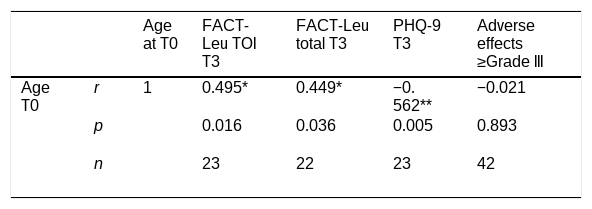
Influence of patient age on quality of life and depressionThe associations between age, QoL, and depression at six months (T3) post-allo-HSCT were investigated using Pearson correlations (Table 5), incorporating aGVHD and the occurrence of adverse events to account for their potential confounding effects on QoL and depression outcomes. Due to mortality and missing PHQ-9 (n = 23) and FACT data (n = 23 or 22) at T3, the total sample size consisted of only 22 or 23 patients (Table 5).
Correlations between patient age at T0 and quality of life measured by the Functional Assessment of Cancer Therapy - Leukemia (FACT-Leu) total score and FACT-Leu treatment-related score, as well as the Patient Health Questionnaire-9 summary score. Also included are calculations for adverse effects up to T3.
| Age at T0 | FACT-Leu TOI T3 | FACT-Leu total T3 | PHQ-9 T3 | Adverse effects ≥Grade III | ||
|---|---|---|---|---|---|---|
| Age T0 | r | 1 | 0.495* | 0.449* | −0.562** | −0.021 |
| p | 0.016 | 0.036 | 0.005 | 0.893 | ||
| n | 23 | 22 | 23 | 42 |
FACT-Leu TOI: FACT trial outcome index; PHQ-9: Patient Health Questionnaire-9; aGVHD: acute graft-versus-host disease (graded according to Harris stages); r: regression coefficient; p: p-value; n: number of valid correlations in accordance with the study hypothesis *p < 0.05, **p < 0.01, ***p < 0.001.
Differences in n explained by missing PHQ-9 and FACT questionnaires at T3.
Point-biserial correlations were calculated for relationships involving binary variables (cGVHD and adverse events). Pearson correlations were calculated for the other variables. Adverse events up to T3 were graded using the Common Terminology Criteria for Adverse Events (CTCAE) and Acute Kidney Injury Network (AKIN) criteria.
Correlation coefficients ranging from 0.449 to 0.495 were calculated for the relationship with QoL, and a coefficient of −0.562 was found for the relationship with depression. These correlations are statistically significant (Age/TOI: n = 23; r = 0.495; p = 0.016; Age/FACT-Leu Total: n = 22; r = 0.449; p = 0.036; Age/PHQ-9: n = 23; r = −0.562; p = 0.005). This suggests that older age is associated with better perceived QoL six months after allo-HSCT. Moreover, the negative correlation between age at T0 and depression at T3 indicates lower levels of depression with increasing age (Table 5).
DiscussionThis study examined how depression, PA, and age affect outcomes after allo-HSCT. Meaningful trends and significant correlations were found despite a small sample size.
Depressive symptoms and clinical outcomesThe use of the PHQ-9 without any fixed cut-off value allowed for a nuanced and continuous assessment of depressive symptoms, diverging from earlier studies relying solely on pre-existing psychiatric diagnoses [6,20]. Depressive symptomatology at baseline was not associated with overall survival or relapse rates in the present cohort, contrasting earlier reports suggesting a detrimental impact of pre-transplant depression on survival [6,20,21]. Similarly, in a recent large European cohort, Gjærde et al. were unable to find a link between depression and survival [22].
However, the absence of significant associations with clinical endpoints could be due to other variables, such as molecular risk stratification, which were not considered due to sample size.
The association between depressive symptoms and post-transplant complications was also explored. Contrary to previous findings [20,23], no significant relationships were found in this dataset. This may be due to the aggregation of all adverse events, including treatment-related toxicities like mucositis, which could mask associations with rarer, psychosocially influenced complications. Similarly, no significant association between depression and engraftment kinetics was observed, aligning with findings from the broader literature [22].
Depression and quality of lifeThe most robust finding was the significant negative correlation (n = 21; r = −0.456; p = 0.038) between baseline depressive symptoms and QoL at T3, assessed using the global FACT-Leu total score. This aligns with prior research [24,25], although earlier studies assessed both variables at the same time. The findings of this study suggest a lasting impact of pre-transplant depression on long-term QoL, emphasizing the value of an early psychological intervention. The low mean PHQ-9 scores (6.53 at T0) falls below standard clinical thresholds (e.g. 10 points for clinically relevant depression) [26], yet still correlated with reduced QoL, supporting the use of lower intervention thresholds or continuous scoring approaches rather than dichotomous cut-offs.
These findings underscore the necessity of routine psychological screening and support, especially given that depressive symptoms can persist or remain stable post-transplant.
Physical activity and clinical outcomesContrary to earlier studies [9,27], no statistically significant association was found between PA levels and overall survival, relapse, or complications. However, a trend-level negative correlation was observed between baseline activity (MET-min/wk) and the 1-year relapse rate (r = −0.339; p = 0.097), as well as overall complication burden (r = −0.343; p = 0.094). These findings, although not statistically significant, suggest a potential protective role of higher baseline activity that merits further investigation in larger cohorts. Furthermore, unlike the findings of Dimeo et al. in autologous HSCT, no relationship was observed between PA and engraftment time [8,9].
Thus, the influence of PA in allo-HSCT remains largely unclear, although existing evidence suggests that advantages might be identified in larger cohorts.
Age as a predictor of quality of life and depressionThe most striking finding was the association of older age with better QoL and lower depressive symptoms at T3. Earlier studies showed that older age predicted higher levels of depression [28,29], though those studies employed the Hospital Anxiety and Depression Scale (HADS) and often evaluated patients later than the present study. At six months post-transplant, patients frequently experience persistent physical and psychological burdens stemming from the intensive nature of allo-HSCT, which can contribute to elevated levels of depressive symptoms.
Concerning the influence of age on QoL, previous studies describe inconsistent findings. While the elderly often report worse physical functioning, some evidence suggests better social or psychological well-being [30–32]. In contrast, younger patients in remission have shown higher overall QoL scores [33]. These discrepancies are likely due to differing subgroups and measurement tools. The current study focused on broader QoL domains, avoiding detailed subscale analysis due to its limited sample size. Interestingly, these results suggest that younger patients are more prone to detrimental psycho-oncological results after allo-HSCT.
These findings may reflect greater psychological resilience, more developed coping mechanisms, or a broader life perspective among older patients. In contrast, younger adults may experience a heightened sense of vulnerability and psychological burden when facing a life-threatening disease [34]. Like young adults, children also experience increased anxiety (35% moderate-severe) and with increasing age, up to 60% have moderate-severe depression [35]. Younger patients still have many personal and professional goals and are in different life situations than older people, which could be possible reasons for the observed age effect. Nevertheless, selection bias and differences in life expectancy, social roles, resilience, or coping strategies may offer alternative explanations for the observed ‘age effect.’ Given the small sample size, causal inferences regarding this effect should be drawn with caution and require confirmation in larger cohorts; nevertheless, these preliminary findings warrant further exploration using more robust statistical measures.
As expected, the severity of aGVHD was associated with lower QoL and higher depression scores, yet no significant association was observed between age and the incidence of GVHD or adverse events, suggesting that the age-QoL relationship is not mediated through differential treatment tolerance, although multivariate models would be necessary to confirm such assumptions.
Clinical implicationsThe findings of the current study suggest that age alone should not exclude patients from allo-HSCT, thereby emphasizing individualized decision-making. This study underscores the need for tailored psycho-oncological support, especially for younger adults and those with baseline depression. The routine use of validated screening tools like the PHQ-9 and possibly customized interventions [36] could improve long-term recovery and patient satisfaction. Notably, continuous scoring approaches in conjunction with clinical impressions may better identify patients at risk.
Study limitations and future directionsThe most prominent limitation of this study is its small sample size, which limits generalizability and statistical power. Several observed trends may have reached significance in a larger cohort. Particularly, the statistical findings are weakened by the lack of multivariate analyses resulting from the small sample size and numerous missing values, which could have led to overfitted or misleading models. Consequently, these findings remain exploratory and less robust, and direct clinical consequences are hardly justifiable based on this study. This becomes even more apparent at T3, where a large part of the cohort had died and a bias towards the healthier, less at-risk patients, might have developed. Additionally, the large volume of questionnaire items (186 across 14 instruments) may have led to cases of non-completion, reducing analyzable data and possibly introducing bias. Digital tools may improve adherence and data quality in future efforts [37].
Furthermore, the observational design and absence of multivariate analysis limited control over confounders. Nonetheless, the study offers valuable feasibility data and emphasizes the importance of including psychosocial metrics in allo-HSCT research, especially for long-term survivorship and QoL. Given the small sample and losses, these findings are exploratory and hypothesis-generating. Moreover, patient recruitment was conducted partially during the COVID-19 pandemic; therefore, the influence of these circumstances on depression levels and quality of life cannot be definitively ruled out.
ConclusionThis pilot study illustrates the importance of incorporating psychological and behavioral variables into the assessment of patients undergoing allo-HSCT. Future studies should employ larger, multi-institutional samples and integrate both clinical and psychosocial endpoints to fully elucidate the interplay between mental health and transplant outcomes.
Author contributionsP.L, A.N., W.R. and C.T. designed the study. P.L., S.S., A.N. and C.T. wrote the paper, J.A.S, K.S., E.M., E.W., M.D., P.vB., L.B. and W.R. reviewed the paper, P.L., S.S., L.B., and C.T. performed statistical analysis. All authors contributed to patient treatment, data preparation, literature search, interpreted results, and approved the final manuscript.
Ethical review boardThe study was proofed and recommended by the local ethic committee of Philipp University Marburg (Number: Az 147/20).
Data availabilityThe data that support the findings of this study are available from the corresponding author upon reasonable request.
The authors have no conflict of interest related to this work.
The authors would like to thank all patients and their families for their support of this study. This study was supported by the German José Carreras Leukemia Foundation (AH06-01 to A.N.) and by Deutsche Forschungsgemeinschaft (SFB 289 to W.R.).